In today’s digital economy, applications are the core of business success. Whether it’s a banking app enabling secure transactions, a retail app driving eCommerce growth, or a healthcare app ensuring real-time assistance—performance matters. Users expect instant responses, seamless navigation, and zero downtime. This is where app performance management (APM) becomes a business-critical strategy.
A single delay of one second in app load time can reduce user satisfaction by up to 16% and drop conversions by 7%. Worse, 88% of users abandon apps due to performance issues. For companies, poor application performance means loss of revenue, brand reputation damage, and increasing operational costs.
This article explores what app performance management is, why it matters, how it works, and the best practices to ensure flawless user experiences.
What is App Performance Management?
App performance management is the continuous monitoring, analysis, and optimization of application health, speed, and stability throughout its lifecycle. It ensures:
Applications perform efficiently under all workloads
Users receive fast and uninterrupted digital experiences
Technical teams detect and fix issues before they impact customers
APM focuses on metrics like response time, error rates, uptime, throughput, and user interactions to maintain peak performance across devices, networks, and geographies.
Why App Performance Management Is Crucial
1️⃣ Enhanced User Satisfaction
Customers today have zero tolerance for slow or crashing applications. APM helps maintain consistently high performance that delights users and builds loyalty.
2️⃣ Higher Business Revenue
Every millisecond matters—faster apps directly lead to:
More conversions
Higher engagement
Longer customer retention
For digital-first companies, APM is a growth enabler.
3️⃣ Improved Operational Efficiency
Proactively identifying bottlenecks reduces:
Production failures
On-call firefighting
Infrastructure overuse
It helps optimize system resources and reduce costs.
4️⃣ Strengthened Brand Reputation
Unplanned downtime or frequent errors can push users toward alternatives. APM preserves your brand image by ensuring a reliable digital presence.
Key Components of App Performance Management
App performance management typically covers five major areas:
✔ Application Monitoring
Monitoring real-time performance data like:
Response time of services
API latency
Number of concurrent users
Slow transactions and database calls
✔ Infrastructure & Server Monitoring
Ensures CPU, memory, storage, containers, and network are functioning at optimal levels.
✔ End-User Experience Monitoring (EUEM)
Tracks:
User interactions
Session performance
Geographic behavior patterns
Helps teams emulate and improve actual user experience.
✔ Dependency Tracking
Apps rely on microservices, third-party APIs, databases, and cloud platforms. APM tools detect failures in any dependency that cause downtime.
✔ Root Cause Analysis (RCA)
AI/ML-enabled analytics quickly identify:
Faulty scripts
Code inefficiencies
Configuration issues
Traffic overloads
This speeds up resolution and shortens Mean Time to Repair (MTTR).
How App Performance Management Works
APM tools follow a cycle:
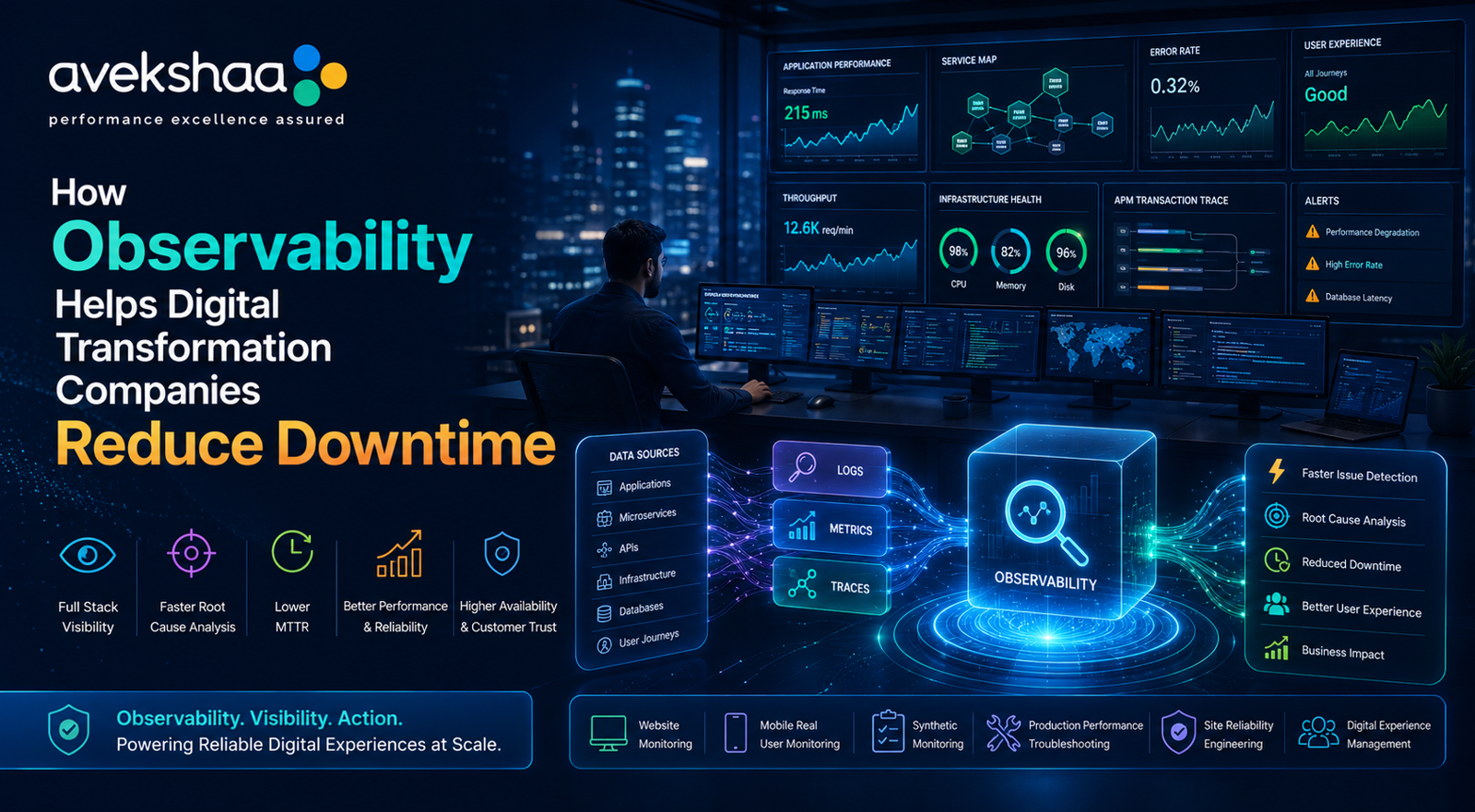
1️⃣ Collect performance data from servers, databases, networks, and user activities
2️⃣ Correlate telemetry with app behavior
3️⃣ Visualize insights through dashboards and alerts
4️⃣ Detect anomalies with automated intelligence
5️⃣ Provide actionable diagnostics to fix issues faster
This ensures both reactive troubleshooting and proactive optimization.
Common Performance Challenges APM Solves
Challenge Impact How APM Helps High load traffic spikes Slowness, downtime Auto-scaling and capacity planning insights Poor database performance Long response times Query optimization and caching strategies Code-level inefficiencies CPU overload, errors Pinpoint problematic transactions Network latency Delayed user interaction Monitors CDN and routing paths Third-party failures Broken functionality Identifies external dependency issues
Benefits of Implementing App Performance Management
Predictable performance under stress
Faster issue resolution with intelligent insights
Better productivity for DevOps and engineering teams
Reduced performance defects entering production
Optimized cloud and infrastructure spending
Competitive advantage with resilient applications
In short, APM is the backbone of digital reliability.
Technologies Driving Modern App Performance Management
With cloud adoption and microservices exploding, modern APM solutions use:
AI & Machine Learning for automated anomaly detection
Distributed Tracing for tracking service-to-service calls
Real User Monitoring (RUM) and Synthetic Monitoring
Observability frameworks (OpenTelemetry, Grafana, Prometheus)
Predictive analytics for proactive remediation
This shift ensures not only visibility but also intelligence-driven performance management.
App Performance Management Best Practices
To unlock the full potential of APM, companies should:
🔹 Implement APM early in the SDLC
Shift-left approach detects performance issues before launch.
🔹 Set performance benchmarks
Define SLAs and SLOs for response times, uptime, and reliability.
🔹 Focus on end-user experience
Measure performance from the user’s perspective, across devices and geographies.
🔹 Use Automated Root Cause Analysis
Rapid diagnostics reduce burnout for IT operations teams.
🔹 Continuously optimize
Iterate performance improvements through real-time insights.
🔹 Collaborate across Dev, QA & Ops
APM should unify performance ownership across teams.
Popular APM Tools in the Market
Some top solutions include:
Dynatrace
AppDynamics
New Relic
Datadog
Splunk Observability
SolarWinds APM
Companies choose tools depending on environment complexity, scale, and performance needs.
The Future of App Performance Management
As businesses adopt cloud-native architecture, edge computing, and AI-driven operations, APM is evolving into:
Self-healing applications
Predictive performance optimization
Full-stack observability
Autonomous operations (AIOps)
Future APM isn't just about monitoring—it ensures business continuity with automation and intelligence.
Final Thoughts
App performance management is no longer optional—it is a strategic investment. A well-implemented APM approach ensures:
✔ Fast, smooth, and error-free digital experiences
✔ Higher business profitability and customer trust
✔ Better resilience in a competitive digital world
In a landscape where user expectations are rising every day, the businesses that prioritize app performance will be the ones that thrive.





Write a comment ...